Boots on real hardware
Its own boot loaders for BIOS and UEFI, starting from a USB stick or a disk. Tested on a laptop and a blade server, and in virtual machines.

RUNA is an operating system with its own kernel, written from scratch. To programs it is a familiar Unix: the POSIX standard, a shell, the usual utilities. Inside, everything is built anew.
RUNA runs on x86_64 and ARM processors, in virtual machines and on real computers, from a laptop to a blade server.
This is no longer a teaching kernel but a working system: it boots, runs programs, works with disks and the network, and tells you about its own state.
Its own boot loaders for BIOS and UEFI, starting from a USB stick or a disk. Tested on a laptop and a blade server, and in virtual machines.
Processes and threads, a shell, pipelines, background jobs, signals. Ordinary Unix programs build and run without changes.
Work is spread across the cores, each with its own queue of tasks. A real-time mode serves tasks that need a quick response.
Virtual memory, several file systems, modern SATA and NVMe disks.
PCI Express with hot-plug, network cards, device isolation. Routing, bridges and virtual networks, network sockets for programs.
Processes, processor load, memory and hardware are visible as ordinary files. A dedicated utility describes the whole machine and points out what is misconfigured.
How RUNA is built, in plain words.
November 2026
RUNA's kernel is not Linux, yet its whole userland runs on musl. How the port works, why it touches only four of musl's files, and what it took to get threads right.
Read the article →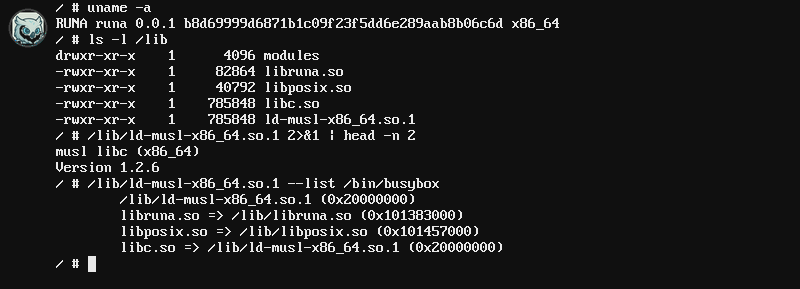
RUNA is a young system, and we say plainly what it does not have yet.
TCP in the new network stack is still in progress. There is no USB, graphics acceleration or sound. POSIX compatibility is broad but not yet complete. There is a real-time mode, but the system does not give hard real-time guarantees. It has been tested in virtual machines and on a few real computers, not on a wide range of hardware.
List address: devel@openruna.net.
To subscribe, write to devel+subscribe@openruna.net and confirm. Only subscribers can post; this keeps spam out.